In the late ’90s I went to Death Valley a few times with my girlfriend at the time, a fellow aspiring desert rat. The first time we drove north from Los Angeles, taking the 5 to the 14 to the 395 and exiting before the town of Ridgecrest on a two-lane county thoroughfare that splits through the overlap of the Mojave and Great Basin deserts called Trona Road. On the way we drove through the eponymous hamlet of Trona, a tiny company town outpost of a few thousand people. We stopped and poked around the desolate, all-but-deserted community and stuck our heads inside a huge, three-story cathedral made entirely of whitewashed cinderblocks. We had to leave after wondering at the people who worshipped in the cool, shaded confines of this high desert vestibule, as we were concerned about securing a weekend campsite in Death Valley. I wanted very badly to find a reason to return to Trona.

I started reading up on the town and found a community calendar that listed a Trona Gemo-O-Rama festival that was celebrating it’s 63rd year. The story I wrote about my weekend there ran in the October 22-28, 2004 edition of the LA Weekly, but without any pictures. I complete the tale with a bunch of photos that I took …
Diamonds in the Rough
Words and photos by Daniel Chamberlin
Originally published in the LA Weekly on October 22, 2004
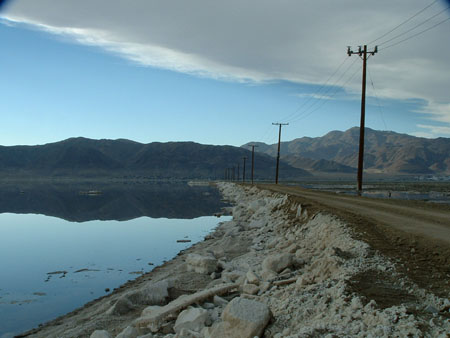
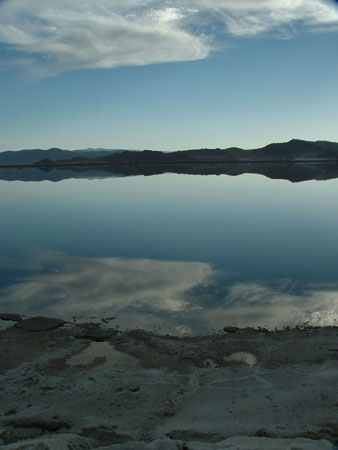
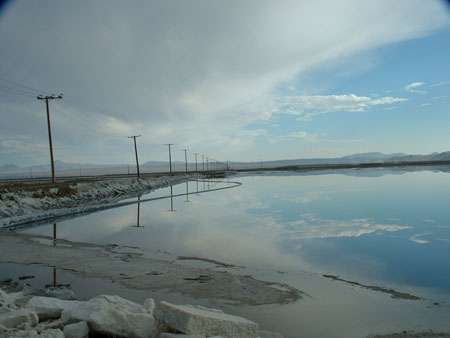
When you walk out on the dry, brittle surface of Searles Lake, sunbaked salt crystals break off and blow across the ground, tinkling like ice on hard-pack snow. The salt flats cover 35 square miles of Great Basin desert that ranges from fields of crystalline dirt with the texture and temperature of a freshly baked pie crust to pristine reflecting pools of odorous effluence from the nearby mineral-extraction facilities. In order to keep ducks from landing here, electric hawk machines scream from power-line poles, and propane cannons fire off harmless explosives. Trona, the town of 2,000 residents that sits on the western edge of this landscape, is a rugged, lonely place that appears to be growing more desolate by the year.
Trona was founded on this plain between the Argus and Slate mountain ranges because of the borax, soda ash and potash that has been mined here since 1908. At its peak, the town’s population exceeded 3,000. But now people move away and leave their homes empty. A year or two ago, a serial arsonist began burning down the abandoned houses, and charred hulks still stand between sandy yards decorated with rusty desert artifacts. In one yard, a commercial fishing trawler warps in the heat. My guide, Jim Fairchild, is a semiretired chemical engineer working for Searles Valley Minerals, Inc., the company that currently operates the three plants in the area and which is the only significant employer for miles. He’s also the publicity coordinator for the Searles Lake Gem and Mineral Society (SLGMS). He’s lived here since 1963 and insists that the triple-digit summer temperatures aren’t that bad. It’s a dry heat, he explains.
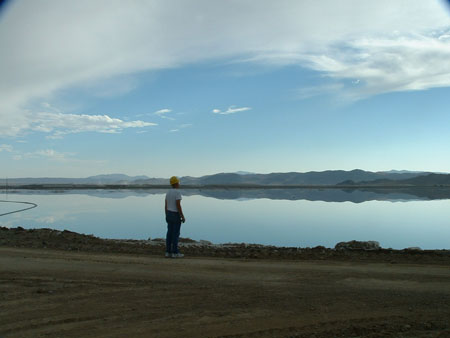
The SLGMS’s annual Gem-O-Rama has been held the second weekend of every October since 1941. It’s Trona’s biggest event, the only time that the town serves as a destination for people not associated with the mining industry. The festival was started by town matriarch Annie Pipkin, a woman known for organizing raucous dances and for the box of live rattlesnakes she kept on her porch. This year, 21 vendors have turned the SLGMS building into a bustling marketplace of quartz crystals from Arkansas, trilobite fossils from Morocco and tourmaline from Brazil. There’s also jewelry, Native American–themed artwork and demonstrations of lapidary equipment. But the big draw for the nearly 800 pilgrims to this scorched stretch of desert are the field trips to the salt flats.
Vehicles start lining up in the SLGMS parking lot at 6:30 a.m. on Saturday. Since there are no restaurants to speak of, everyone heads over to the Trona Community Church for an all-you-can-eat pancake breakfast. At 9 a.m., a caravan of 250 cars, trucks and RVs begins the slow, 5-mile haul to the Mud Piles.
A week or so before Gem-O-Rama, a fleet of backhoes digs up 50 tons of the briny mud from beneath the surface of the flats.
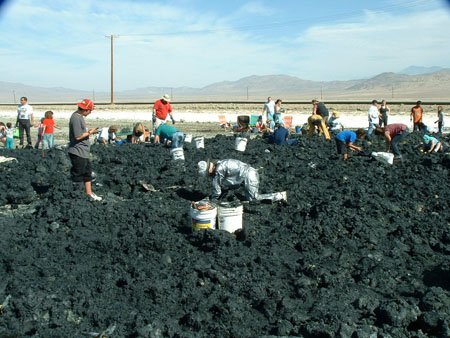
The mud is then spread out into two knee-deep swaths. It’s into this mess that hundreds of mineral collectors plunge in search of greenish-brown hanksite crystals. Some wear thigh-high rubber waders and thick gloves; others wallow in cutoff sweatpants and ragged tank tops. They attack the mud with shovels and pickaxes, or sink their arms up to the elbow into the sticky sludge in order to haul out chunks of minerals. Steve, an environmental geologist from Arizona with a mighty gray ponytail, toils with his friend Tyler at scrubbing their 150-pound chunk of hanksite clean. One man wearing a silver jumpsuit crawls through the mess on all fours, his eyes scanning for the perfect mineral cluster.
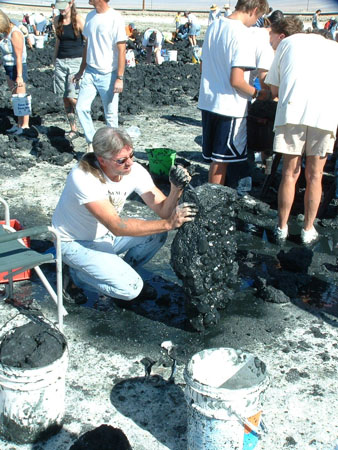
A larger group assembles that afternoon for the Blow Holes field trip, an expedition to a constellation of 50-foot-deep holes that were drilled earlier in the week and into which explosives were planted. Upon detonation, thousands of crystal shards
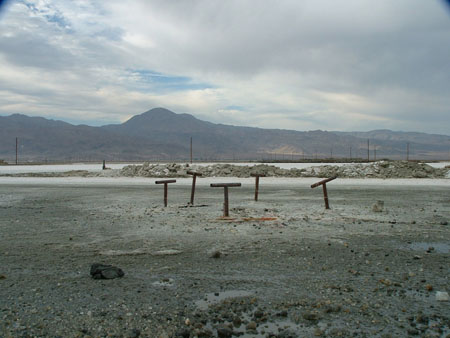
were thrown into the air and scattered about the plain. The day of the field trip, a huge steel tube is inserted into the most recently drilled hole and compressed air is pumped into the sea of brine that rests below. The crowd gathers in a wide radius around the metal tube, which spews a frothy mixture of toxic fluid and crystal debris. This goes on for a good 15 minutes while folks gnash their teeth at the sight of large hanksite and sulfohalite crystals tumbling through the air. Once the flow stops, the diehard rock hounds surge forward in a mad scramble. “Geezus!” exclaims one dad when his son presents him with a heavy bucket brimming with the nearly worthless gems. “What are you gonna do with all this stuff?”
Nearby, a little girl crouches next to her father, a muscle-bound desert rat whose tattoos are obscured by his deep-red sunburn. “Diamonds!” she laughs, running her hands through the minerals piled thick around her knees. “Precious, precious diamonds!”
As the field is cleared and the plant engineers grapple with the pipe, preparing to blow the hole again, one Trona resident turns to her neighbor and sighs. “Right now all the little boys are thinking, ‘I want to work at the plant when I grow up,’” she says.
“If we’re still in Trona then,” the woman next to her replies, “they probably will.”
© 2007 Daniel Chamberlin
More Into The Green:
• Kelso Dunes, Mojave National Preserve (Part 1 of 3)
• Old Growth: Indiana Pioneer Mothers Memorial Forest – December 28, 2008
• Glendale Narrows, Los Angeles River – October 14, 2008
• Rancho Mesa, Mojave Desert – October 12, 2008
• Tempe, AZ – November 15-17, 2008






 intothegreen.org