
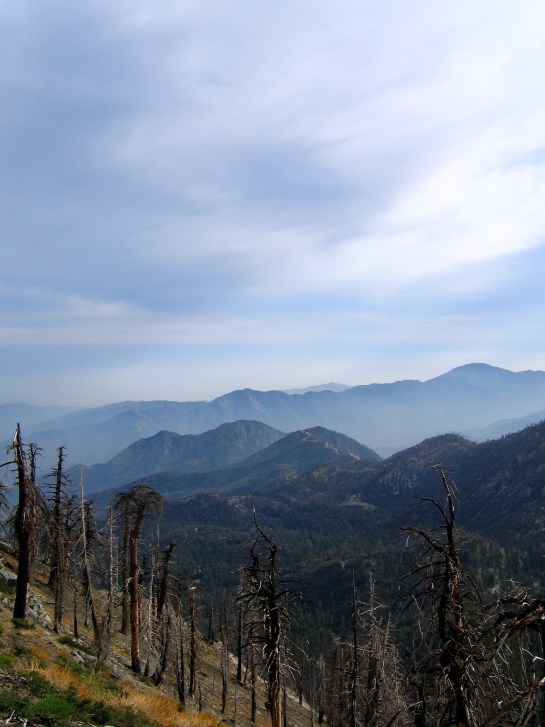
The first time I walked up Mt. Islip — an 8,000 foot peak in the San Gabriel Mountains, about 50 miles from my house in Northeast Los Angeles — I came down by moonlight sort of by accident. I tend to get a late start on a lot of my hikes, mostly because I enjoy weekend mornings zoning out on my porch listening to Francoise Hardy, drinking a cherry-walnut smoothie and watching my cat Spider run around in the yard.
The trail is an easy three or four miles one way, and I arrived at the top just as the sun was starting to set, barely making out the towers of downtown Los Angels through the orange haze. I hung around on the peak — bald rock with four chunks of cinder block, the foundation of a long-gone fire watchtower from the 1930s — until the light was mostly gone. It wasn’t until I was making my way down in the dusk when it occurred to me that the woods were still crawling with hunters. It was the heart of deer season, November 5, 2006, and the Islip Saddle parking lot had been full of pickup trucks and camo-sporting Latino dudes hanging out with their freshly-killed deer carcasses rather than the usual crowd of white granola-types and their Subaru Outbacks.

The moon came up over the mountains about an hour after dark, illuminating every crooked branch of the trees on the fire-scarred ridgeline above me. It glowed and sparkled silver on the rock that sloped up from the fire road I was walking, and it shined in the arc of pee that I sent running down the closed, two-lane blacktop highway that I’d followed to the trailhead. (The Angeles Crest Highway has been closed with a heavy gate at mile 64.1 for months now, I think because of some rockslides further east.) I was singing a jolly country song about a guy who killed a woman in Tennessee and was now running for the Mexico border when I realized that two hunters, sitting by the side of the road, had been watching me from a distance as I ambled along, dancing and urinating gratuitously in the middle of the road. Yeesh. “Buenas noches, cazadores,” I said, remembering the word for “hunters” from a tequila bottle. “Uh-huh,” they replied, understandably unimpressed. They asked me if I’d seen their friend, who was long overdue at the parking lot. I told them I hadn’t seen anyone, and walked on.
 intothegreen.org